ECOHEAT Project
Effective solutions for the recovery and utilisation of
waste heat from complex industrial flue gases
Project coordinated by the RAPSODEE Centre, IMT Mines Albi
Duration: 4 years
A budget of 2.67 million euros
1 industrial partner: Eco-Tech Ceram (SME)
Background and challenges
According to France’s SNBC (National Low-Carbon Strategy), in order to achieve the goal of carbon neutrality by 2050, the French industrial sector is expected to reduce CO₂eq. emissions by 81 per cent in 2050 compared with 2015. Among the key measures recommended by the SNBC is the requirement to significantly improve the energy efficiency of industrial processes (i.e. a 20–40 per cent improvement by 2050 compared with 2015). To achieve this, approximately 10 TWh/year of waste heat at temperatures above 100 °C (corresponding to around 19 per cent of the total waste heat potential quantified by ADEME in 2017) should be recovered by 2030.
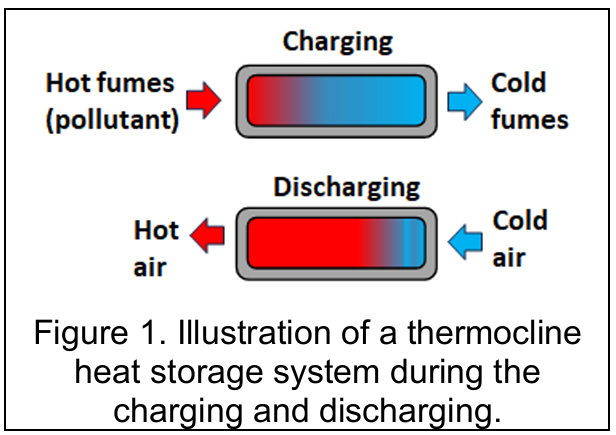
Of the various technical solutions developed for thermal energy storage – and more specifically for the recovery of waste heat – thermocline sensible heat storage is the most mature technique in industrial terms. The most widely used sensible heat storage systems were first deployed in the 1980s for concentrated solar power plants. More recently, thermocline-type storage systems have also been deployed on an industrial scale for the recovery of waste heat. The risk of corrosion is expected to be higher for ‘complex flue gases’ from other industrial sectors such as metallurgy, cement production, glass manufacturing, etc., which contain higher levels of pollutants than ‘clean flue gases’. The simultaneous occurrence of corrosion and thermomechanical fatigue can have a combined effect: corrosion can accelerate thermomechanical fatigue, and vice versa. Thus, in order to effectively recover the waste heat contained in ‘complex flue gases’, it is essential to understand and control the phenomena occurring within the thermocline storage system. It should be noted that ‘complex flue gases’ account for approximately 80 per cent of the total waste heat resource, and that the majority of this
has not yet been recovered.
Scientific objectives
The ECOHEAT project is dedicated to fundamental research into the corrosion and thermomechanical behaviour of metallic and ceramic materials in direct contact with complex flue gases across a wide temperature range (from a few tens to a few hundreds of °C). In particular, the combined effect of corrosion and thermomechanical fatigue will be investigated.
The ultimate objective of the ECOHEAT project is to generate sufficient data on corrosion and thermomechanical fatigue for various ‘material/environment’ systems and to validate a numerical model, which will enable the correct design of future thermocline storage systems for the recovery of ‘complex flue gases’. The technical, economic and environmental impact of the selected solutions will also be assessed. To achieve these ambitious objectives, the ECOHEAT project is drawing on the relevant expertise of both academic and industrial experts in the fields of corrosion science, materials mechanics and process engineering.
The consortium

More projects