IMPALA Project
Electric radiant heaters optimised for the design of
sustainable high-temperature hybrid furnaces
Project coordinated by the CNRS
Duration: 4 years
A budget of 2.8 million euros
1 industrial partner: Saint-Gobain – PCR
Scientific objectives
IMPALA aims to develop a new range of black-body electric radiators (iERH) capable of providing a breakthrough solution for the decarbonisation of high-temperature (HT) industrial furnaces. The iERHs must have a service life of at least 8 years, which is an essential requirement for their deployment on an industrial scale. In order to surpass the heating capacities of natural gas burners, currently used in many HT processes, the iERHs will need to operate at temperatures of up to 1,600 °C in corrosive gaseous atmospheres, representative of those used in future hybrid-heated furnaces. The iERHs will be designed using a ‘material-by-design’ approach based on topological optimisation (TO) coupled with artificial intelligence (AI) tools, whilst taking into account forming and ageing constraints.
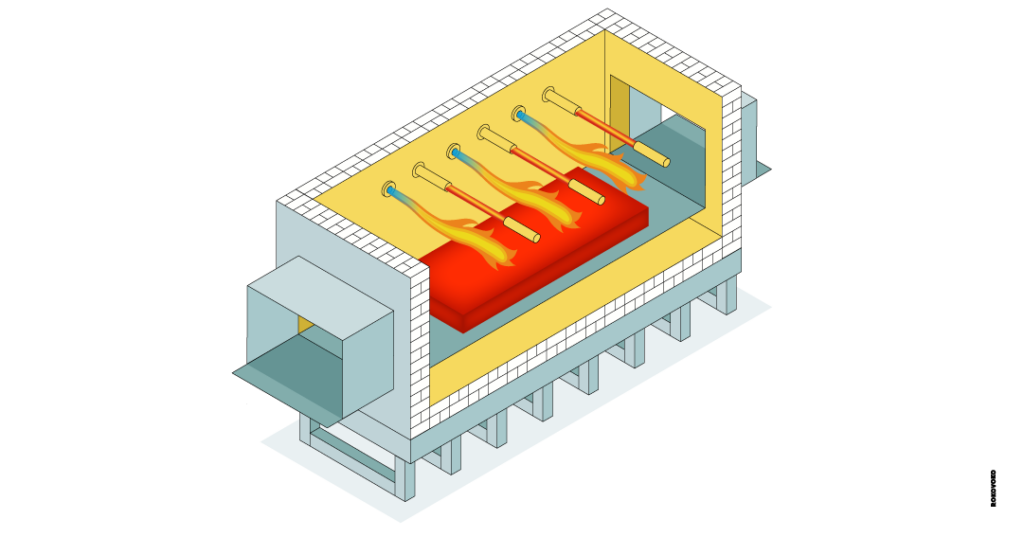
To this end, IMPALA will model the heating of a nickel-rich alloy tubular specimen at 900 °C, which will be placed in a 10 kW laboratory electric furnace (10 kW LEF) with mullite walls. The thermal modelling will account for radiative transfer using two complementary computational approaches (stabilised FEM, Monte Carlo algorithm coupled with a path-space formulation) as well as the radiative thermal properties of the key materials (iERH, walls, load). The influence of various corrosive atmospheres (CO₂, H₂O, N₂, NOx, O₂) on key materials will be studied in detail in order to define ageing laws that enable the evolution of their thermal and radiative properties to be tracked. Ageing experiments will be carried out in a laboratory combustion furnace equipped with gas burners (CH₄, H₂, CH₄/H₂) and in high-temperature muffle furnaces fuelled by synthetic gas.
The thermochemical and thermomechanical behaviour of key materials will then be studied to ensure their durability under real-world heating conditions. The base material for the iERH will be a silicon carbide (SiC) ceramic, the grade of which will be selected in close collaboration with Saint-Gobain PCR (Cavaillon, France).
Three types of refractory coatings capable of exhibiting black-body emissivity up to 1,600 °C will be considered. The first Si-C-Al-N layer will be deposited by CVD (SIMAP) using a process that is ready for scale-up. The second layer, based on NiFe₂O₄, will be produced by solution spraying. The third layer will be an environmental barrier (Yb₂SiO₅) deposited by plasma spraying (IRCER). The challenge for IMPALA will be to ensure that the black-body properties of the three coatings remain stable up to 1600 °C, whilst guaranteeing their durability for industrial use.
The consortium