CO₂MET Project
Long-term monitoring and quantification of CO₂ for on-land storage
Project coordinated by IFP Energies nouvelles
Duration: 4 years
A budget of 3 million euros
1 natural experimental site (Sainte-Marguerite, Massif Central)
1 industry case study (Paris Basin, based on PilotSTRATEGY)
Background and issues
CO₂ capture and storage technologies are key to decarbonising the industrial sector. Offshore storage has already proven its feasibility (e.g., Sleipner, Snøhvit), but onshore storage appears necessary to increase storage capacity whilst reducing CO₂ transport. However, the proximity of these sites to local communities makes their deployment uncertain and raises questions regarding public perception.
Long-term monitoring of CO₂ storage sites, as required by the European CCS Directive, presents an opportunity to enhance transparency and local acceptance of storage by involving stakeholders in data collection and interpretation. However,
current monitoring systems do not allow for the simultaneous use of in-situ measurements, numerical simulations and interactive visualisation to achieve an integrated approach to monitoring storage sites.
Scientific objectives
The CO₂MET project aims to develop and advance key units or components (TRL 3–4) in preparation for a future integrated system (TRL 9, not developed within this project) for long-term digital monitoring, thereby improving the reliability and acceptability of geological CO₂ storage.
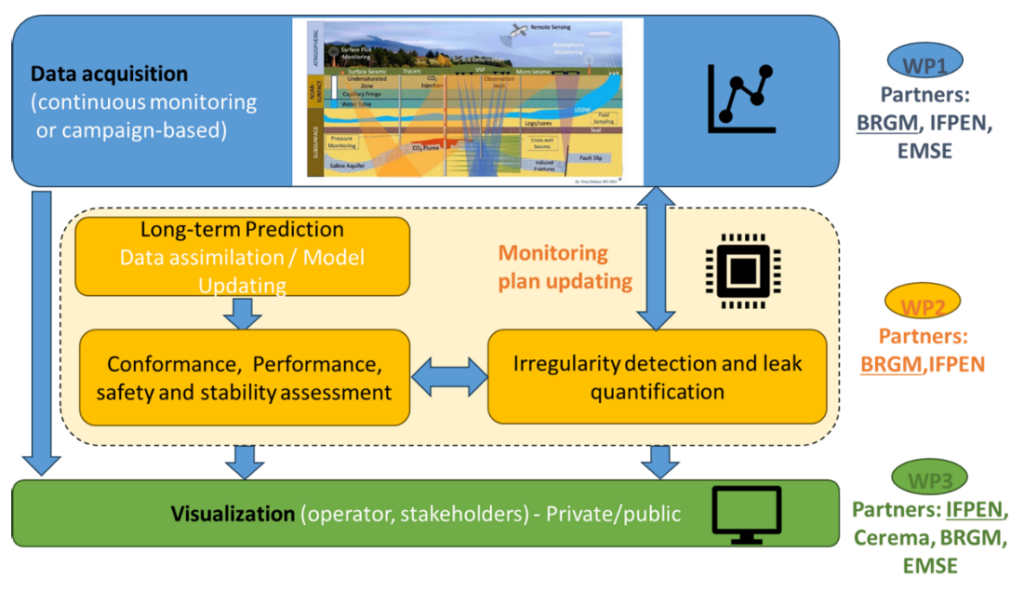
The originality of this project lies in: (1) covering the entire monitoring system chain, which incorporates data acquisition, predictions using numerical simulations of a storage site, performance and safety analysis, and a platform for visualising measured and simulated data; (2) whilst investigating the feasibility and benefits of involving stakeholders through tools for participation in data acquisition and visualisation tools that enable the transparent communication of key information on the evolution of a storage site.
To achieve these objectives, the project aims to develop and advance (WP1) low-cost, robust and technically effective monitoring methods for acquiring field data: gas sensors, coupled biogeochemical monitoring techniques; (WP2) digital tools or methodologies to, on the one hand, provide robust, near-real-time and long-term numerical predictions of CO₂ storage and its geochemical impacts under relevant uncertainties, and, on the other hand, improve the performance of a monitoring system for the detection and quantification of leaks; and (WP3) testing visualisation and participation tools to assess their impact on stakeholders’ understanding and acceptance.
For validation purposes, the monitoring methods and tools developed in WP1 will be tested and validated in the laboratory and at a natural CO₂ emission site in Sainte Marguerite (Massif Central, France). The numerical tools and methods developed in WP2 will be applied to a synthetic case study at industrial scale, based on the French Paris Basin pilot project (H2020 PilotSTRATEGY project) and on the data acquired in WP1. In the final phase of the project, the impact of specific engagement methodologies (visualisation) will be assessed using a structured evaluation protocol combining pre- and post-engagement surveys, focus groups with citizens and local stakeholders, and the analysis of participation indicators on the visualisation tools.
Expected objectives
On completion of the project, CO₂MET will provide:
– Improvements to a multi-sensor gas monitoring system validated in the field,
– A digital workflow tested on a commercial-scale case study,
– A visualisation platform accompanied by an assessment of its use by stakeholders,
– Recommendations for developing citizen science protocols in the context of storage monitoring.
The consortium

More projects