Meeting with François Jérôme
ECOCHEM project coordinator
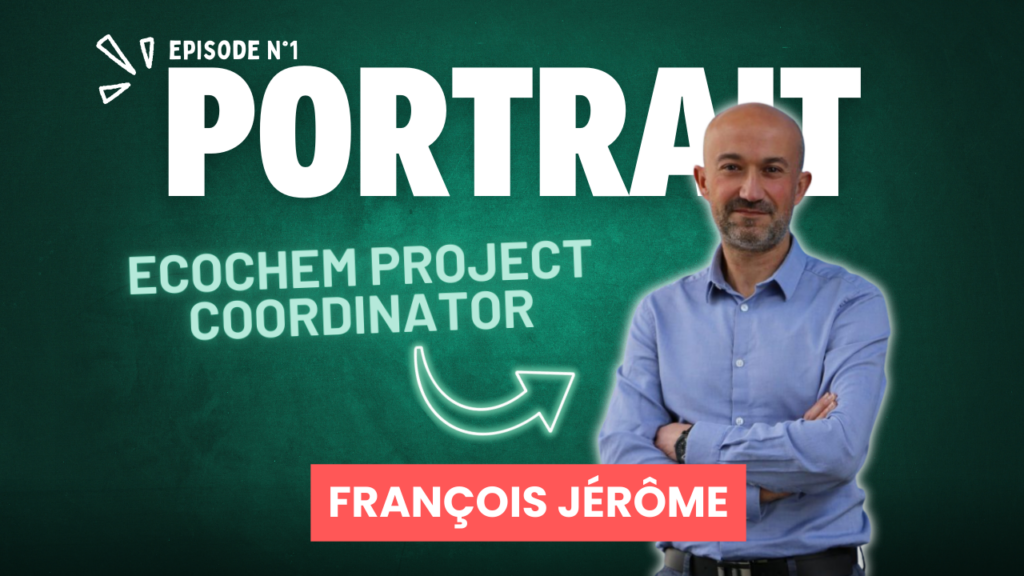
François Jérôme
Research Director at the Institute of Chemistry of Environments and Materials in Poitiers (IC2MP) (University of Poitiers/CNRS) and co-leader of the ECOCHEM project of the PEPR SPLEEN programme for the decarbonisation of industry.
His research focuses primarily on the catalytic conversion of biomass into specialty chemicals. Within this broad field, his scientific expertise is structured around two main areas: (1) the development of cascade catalytic reactions, and (2) the integration of catalysis with alternative activation technologies, in particular grinding and ultrasound. To identify the various scientific obstacles associated with his research, he focuses on several key criteria: reaction selectivity, reactor productivity, catalyst durability, atom economy and energy consumption reduction (i.e. CO2 emissions). In all the transformations studied, he pays close attention to understanding reaction mechanisms, mainly through kinetic studies, the use of model molecules and collaborations with expert colleagues from DFT.
In particular, he is leading the ECOCHEM project of the PEPR SPLEEN, whose main objective is to design breakthrough technologies to carry out catalytic reactions/processes in a more CO2-efficient manner (atom economy, energy economy, selectivity, etc.).
His responsibilities within the ECOCHEM project
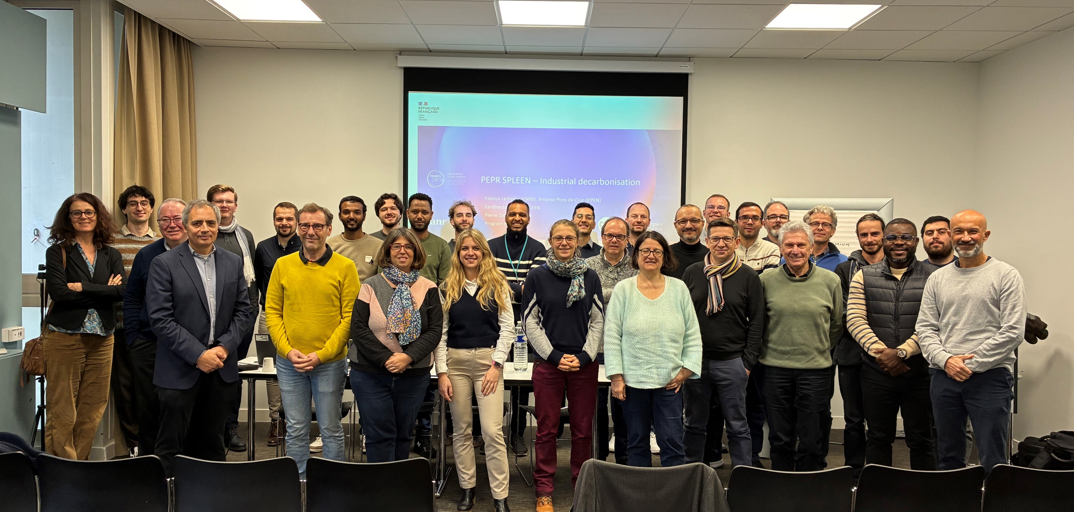
ECOCHEM is coordinated by F. Jérôme (CNRS) and Pierre-Louis Carrette (IFPEN). Together, their mission, beyond purely administrative management, is to ensure the relevance of the project’s scientific orientations (in line with the objectives of the PEPR SPLEEN), its progress, its interface with other PEPR SPLEEN projects and its openness to the socio-economic world, both nationally and internationally. In this context, ECOCHEM relies on a strong network of industrial partners who are regularly consulted and invited to various annual meetings to help ECOCHEM define (1) the most promising targets and (2) the specifications according to the target market. The integration of industrial challenges into the ECOCHEM project as early as possible should accelerate the increase in the technology readiness level (TRL).
Project highlights
The LPCNO’s early-stage project with SATT TTT on magnetocatalysis moved into the maturation phase on 1 November 2024 in collaboration with Altens (Plastomag project, 6 months, renewable once). This project is being carried out at the intersection between ECOCHEM and the targeted POWERCO2 project.
A maturation project (BUBBLE) has been accepted for funding by SATT PROPULSE on 01/02/2026 and concerns the purification of sweet juices using high-frequency ultrasound. In this context, a bridge will be built with the PEPR B-BEST programme.
Important information
To date, there are 15 publications with 13 more in preparation, and there are 6 patents and a declaration of invention currently under evaluation.
IC2MP is involved in a European CBE-JU project, led by MICHELIN and worth €24 million (approval in 2025). The objective for IC2MP and ECOCHEM is to develop new, more efficient catalytic systems (cascade) for the production of monomers.
The ICSM cooperates with the Clean Hydrogen Laboratory at the Hydrogen Research Institute of the University of Quebec at Trois-Rivières. This collaboration is part of a thesis co-supervised by a researcher also involved in the Ecochem PEPR, which led to a mobility programme in France for the preparation of catalysts using a technique studied within the PEPR (sonohydrothermal synthesis of materials).
A partnership between IC2MP and Singapore (NTU, CREATE) has been formalised around the design of cavitation agents, with the aim of reducing the overall energy consumption of this technology.
Collaborations are underway between LPCNO and the Max Planck Institute for Chemical Energy Conversion in Mühlheim, ITQ Valencia, and the Universities of Tarragona and Seville on magnetocatalysis.
The ISCR is leading a doctoral network called ‘ChimSep’ related to the project’s themes. The LGC and IC2MP are involved in the submission of two other doctoral networks, one on the removal of microplastics from drinking water using functionalised ionic liquids (LGC) and the other on mechanochemistry/mechanocatalysis (IC2MP).
The creation of a start-up (CATMAG) dedicated to magnetocatalysis is currently being finalised (LPCNO).
More news News