The seventh planetary boundary has officially been exceeded: ocean acidification
©Crédit Photographie : PIK / montage Valentine Michel
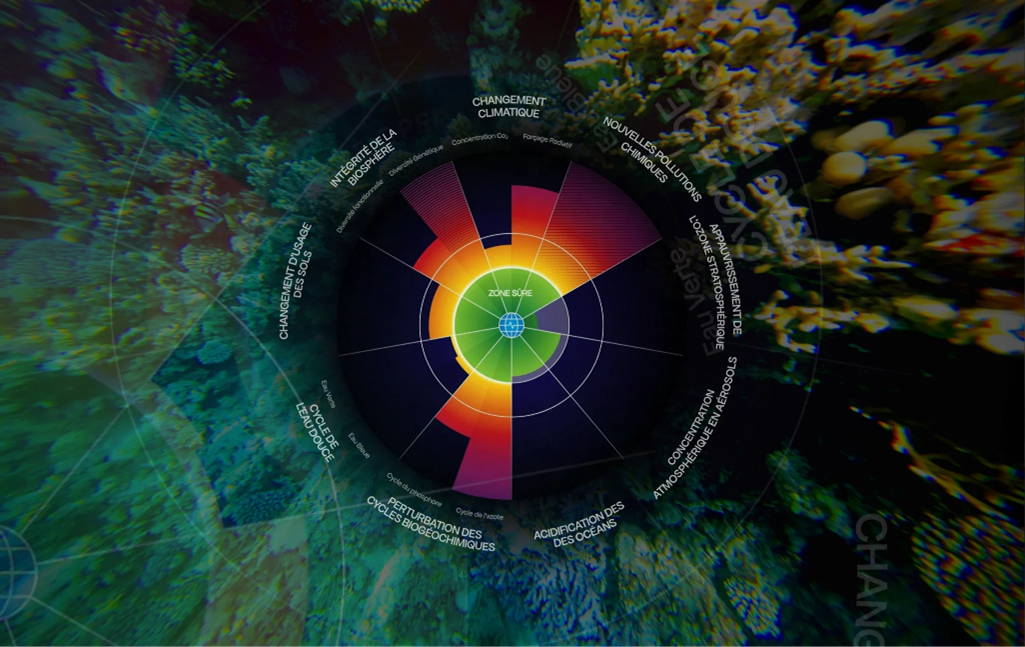
In the report « Planetary Health Check », the Potsdam Institute for Climate Impact Research (PIK) warns that of the nine ‘planetary boundaries’ defined in 2009, the seventh has just been officially exceeded.
This concept, initiated by Johan Rockström and a group of 28 international scientists, aims to identify the major natural systems essential to the stability and resilience of the Earth, climate, biodiversity and forests. The objective is to determine planetary boundaries within which humanity can continue to develop without jeopardising the planet’s balance. In 2009, three of these limits had already been exceeded. By 2025, there are now seven.
Ocean acidification
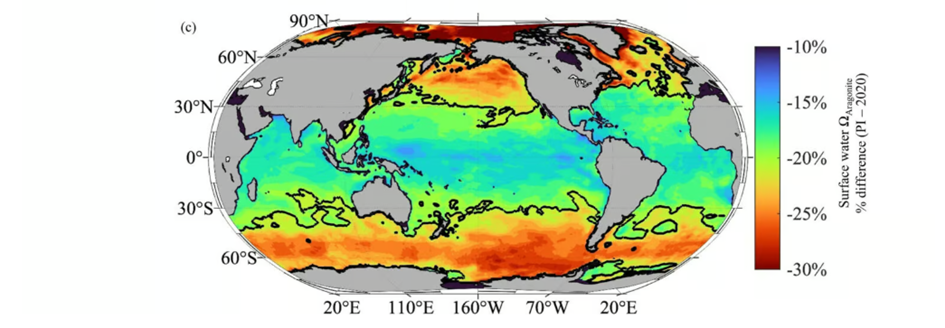
Ocean acidification, which mainly affects polar regions and the Southern Ocean, is caused by the absorption of carbon dioxide emitted by the burning of coal, oil and gas, among other sources. When dissolved in water, CO₂ lowers the pH of the oceans, making the water more acidic. Since the beginning of the industrial era, this acidity has increased by 30 to 40%, representing a drop of 0.1 pH units.
Source : Ocean Acidification: Another Planetary Boundary Crossed (2025)
Measuring the overshoot of the planetary boundary for ocean acidification
To measure how much this limit has been exceeded, scientists use the aragonite saturation state (Ω), which reflects the availability of the carbonate needed for the stable formation of this mineral. The planetary boundary has been set at 2.86 — 80% of the pre-industrial value of 3.57 — to avoid large-scale undersaturation and protect marine calcifiers. According to current data, this limit has been exceeded, confirming the first warning issued in June 2025. Previous, more stringent studies even indicated that acidification had exceeded a safe ecological threshold as early as the 1980s.

The consequences for marine life
The consequences of this overshoot are manifold and worrying. Marine organisms must expend more energy to maintain the chemical balance of their cells, to the detriment of growth, reproduction and their resilience to other environmental stresses. Corals, molluscs, pteropods and certain species of phytoplankton are particularly vulnerable. Acidification also affects fish, disrupting their sense of smell and behaviour, and alters the propagation of sound underwater, making underwater environments noisier. Even non-calcifying species can suffer stress from rising CO₂ levels and falling pH.
Key role of the ocean
The ocean plays a key role in the climate: it absorbs around 25% of anthropogenic CO₂ emissions, thereby limiting atmospheric warming. But this ecological service comes at a cost: it increases ocean acidification, endangering biodiversity and marine ecosystems on which billions of people around the world depend. While industrial policies and innovations, such as efforts to reduce CO₂ emissions and invest in cleaner technologies, are essential, the situation highlights the urgent need to rethink our relationship with the oceans.
Source :
Rapport scientifique du Postdam Institute for Climate Impact Research (PIK) :
https://www.planetaryhealthcheck.org/wpcontent/uploads/PlanetaryHealthCheck2025.pdf
More news News