Sweden: a pioneer in industrial decarbonisation ?
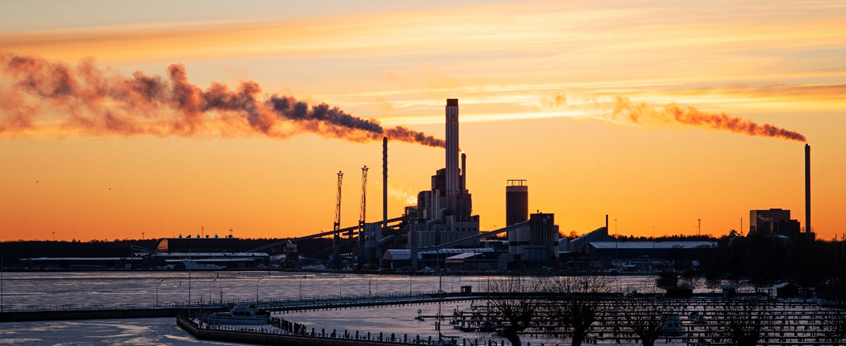
While many European countries are still struggling to green their heavy industries, Sweden stands out as a full-scale laboratory for the transition. Between 1990 and 2013, its CO₂ emissions fell by 22% according to Eurostat. While this figure remains significant, it reflects a dynamic: that of a country that has set itself the ambitious goal of becoming a ‘fossil fuel-free welfare state’ by 2045. For industry, which accounts for 30% of national emissions, the bar is set even higher: achieving net negative emissions.
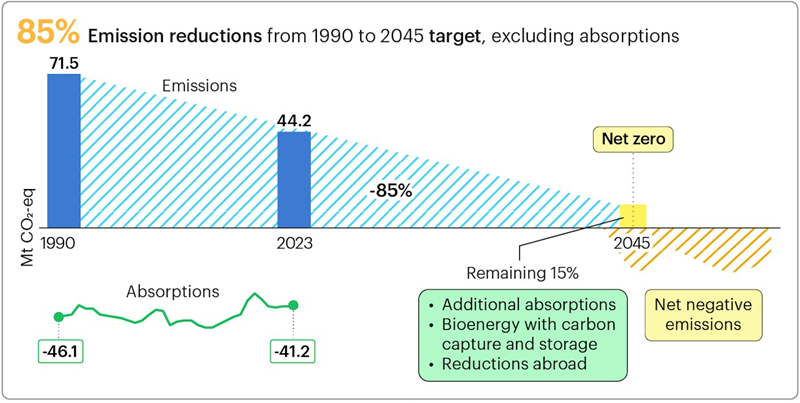
Source: Energy Policy Review Sweden 2024 – IAE
Structural public policies and a favourable electricity mix
The Swedish model is based on an effective three-pronged approach: stringent regulations, technological innovation and clean energy. In 1991, Stockholm introduced a carbon tax, which is now one of the highest in the world (SEK 1,510 per tonne of CO₂, or approximately €137.30). Combined with the European carbon market, this encourages manufacturers to review their practices.
Another decisive advantage is a 99% low-carbon electricity mix, driven by hydroelectricity, nuclear power and wind power. This carbon-free electricity facilitates the electrification of heavy processes and the gradual integration of green hydrogen as a substitute for fossil fuels. Sweden is also a pioneer in the production of green steel based on non-fossil hydrogen.
Le mix électrique de la Suède en 2024/2025
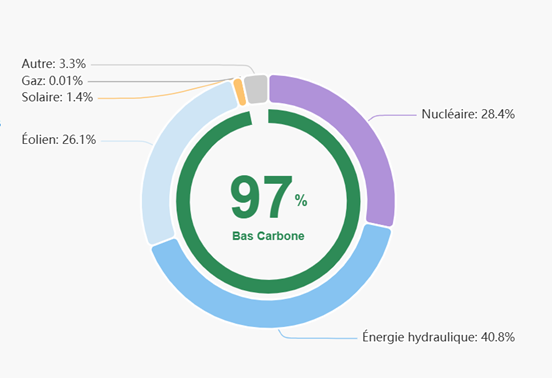
Source: LowCarbonPower
A costly transition with multiple challenges
However, the road to carbon neutrality remains difficult. Industrial processes, particularly in the steel and cement industries, remain particularly energy-intensive. Replacing coal or coke with green hydrogen requires massive investment and a considerable increase in renewable electricity production. Strengthening the electricity grid is therefore a strategic imperative.
International competitiveness is another challenge. Compared to countries with low carbon taxes, Swedish manufacturers face a cost management problem. The European Union’s carbon border adjustment mechanism will be crucial in limiting the risk of so-called ‘carbon leakage’ relocations.
HYBRIT, a concrete step towards low-carbon steel
However, Sweden has no shortage of flagship projects. In Luleå, the HYBRIT project, the result of a partnership between SSAB, LKAB and Vattenfall, demonstrates that it is possible to produce iron and steel without fossil fuels. The ambition is to reduce 10% of national CO₂ emissions. The principle is based on replacing coal coke, traditionally used to extract oxygen from iron ore, with green hydrogen produced from renewable electricity. Instead of generating carbon dioxide during ore reduction, the process only releases water vapour. This technological breakthrough could eventually eliminate almost all emissions associated with steelmaking.
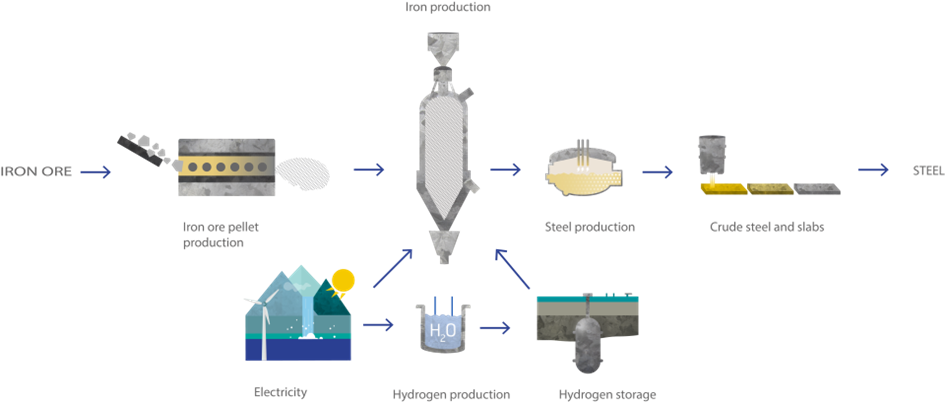
Boden, an industrial project with a European focus
Another flagship project in Sweden’s transition, the steelworks under construction in Boden, in the north of the country, illustrates the ambition to radically transform the steel industry. Led by H2 Green Steel, founded in 2020, this plant aims to produce carbon-free steel on a large scale, using green hydrogen instead of coal. The investment is considerable: around €5.5 billion has been mobilised to build an industrial site that is set to become one of the most modern in Europe. At full capacity, the plant aims to produce 5 million tonnes of green steel per year, reducing CO₂ emissions by nearly 95% compared to traditional processes.
Sweden as a benchmark for industrial transition
The example of Sweden illustrates that the decarbonisation of industry can be achieved through joint efforts by public and private actors in a country. While technical, financial and geopolitical challenges remain, industrial decarbonisation is not only a climate imperative, it also represents an economic and technological opportunity.
By transforming its heavy industries, Sweden is not only reducing its emissions, it is also shaping a sustainable model that aims to reconcile industrial development with climate responsibility.
More news News