From waste to resource: rethinking industrial flows with territorial metabolism
Territorial metabolism: understanding local industrial dynamics
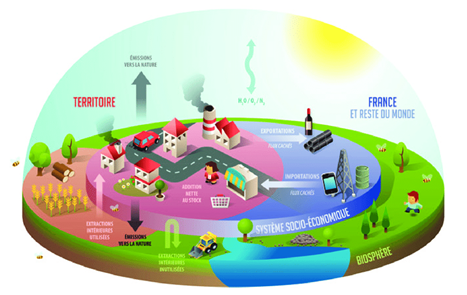
Territorial metabolism, a key concept in industrial and territorial ecology (ITE), refers to all the flows of materials, energy, water, waste and information that pass through a territory. This approach is inspired by the metabolism of living beings: to perform their vital functions, they draw on materials and energy, transform them, and then return them in another form[1]. It allows a territory to be analysed as a complex system in which businesses, infrastructure, institutions and inhabitants interact constantly. In highly industrialised areas, it helps to better understand the environmental impacts of production and to anticipate more sustainable transition strategies.
[1] https://geoconfluences.ens-lyon.fr/glossaire/metabolisme
Diagnosing industrial flows to act effectively
Applied to the industrial context, territorial metabolism involves mapping and quantifying the inflows (raw materials, energy, water) and outflows (emissions, waste, thermal discharges) of businesses in order to identify points of environmental pressure. For example, in the Vallée de la Chimie near Lyon, the carbon assessment carried out in 2020 highlighted the major footprint of this industrial platform, which accounts for 26% of CO₂ emissions in the Lyon metropolitan area, with 98% of these emissions linked to industrial processes. This finding is prompting a reorganisation of supply chains and the development of projects to reduce this impact (solar installations, energy recovery, heating networks, etc.). These assessments serve as a basis for developing industrial and territorial ecology policies.
[1] https://lyonvalleedelachimie.fr/app/uploads/2023/10/LVDC_Communique-Trajectoire-Carbone_30032021.pdf
Promoting industrial and territorial ecology
Territorial metabolism encourages a closed-loop approach to flows by promoting synergies between businesses: waste or effluent from one activity becomes a resource for another. This is the principle of industrial ecology, which has already been trialled on a large scale in Kalundborg, Denmark[1]. Various players – a power station, a refinery, a gypsum factory and a brewery – exchange steam, heat, water and by-products. These industrial exchanges are a concrete illustration of territorial metabolism, where flows are closed within a local system. In France, areas such as the port of Dunkirk and the industrial basin of Fos-sur-Mer are developing similar approaches to limit losses, pool infrastructure and improve the energy efficiency of the productive fabric.
Reducing carbon footprints and relocating resources
This approach also helps identify a region’s vulnerabilities in the face of globalised flows. In times of crisis, many industrial areas have suffered from their dependence on long supply chains. By analysing their metabolism, some local authorities have launched projects to relocate activities (plastic recycling, biomass recovery, local energy production) in order to reduce their carbon footprint and increase resilience. The Hauts-de-France region, for example, is supporting the relocation of the plastic recycling industry to reduce dependence on imports and limit the environmental impact of transport[1]. This type of approach also aims to strengthen local security of supply by ensuring the continuity of essential resources in the face of international uncertainties.
[1] https://www.hautsdefrance.fr/economie-circulaire/
Developing territories according to their flows
Territorial metabolism also influences land use planning, particularly through the planning of economic activity zones. By understanding existing flows and recovery potential, public actors can better organise industrial spaces, establish more efficient logistics platforms or pool networks (water, steam, transport), thereby reducing environmental impacts while strengthening synergies between businesses and infrastructure.
Industrial and territorial governance to be built collectively
Implementing a policy based on territorial metabolism requires collaborative governance, bringing together local authorities, manufacturers, researchers, citizens and stakeholders. This approach combines technical knowledge (material balance, life cycle assessment – LCA, geographic information system – GIS) with the social and economic needs of the territory. Tools such as territorial flow observatories, collective carbon assessments and industrial synergy maps can inform this process. In short, territorial metabolism becomes a compass to guide the transition of industrial territories towards circular, resilient and sustainable models.
More news News